Accessability
Web Design
UX/UI
Let Alliance User Journey Redesign
Nov 27, 2025
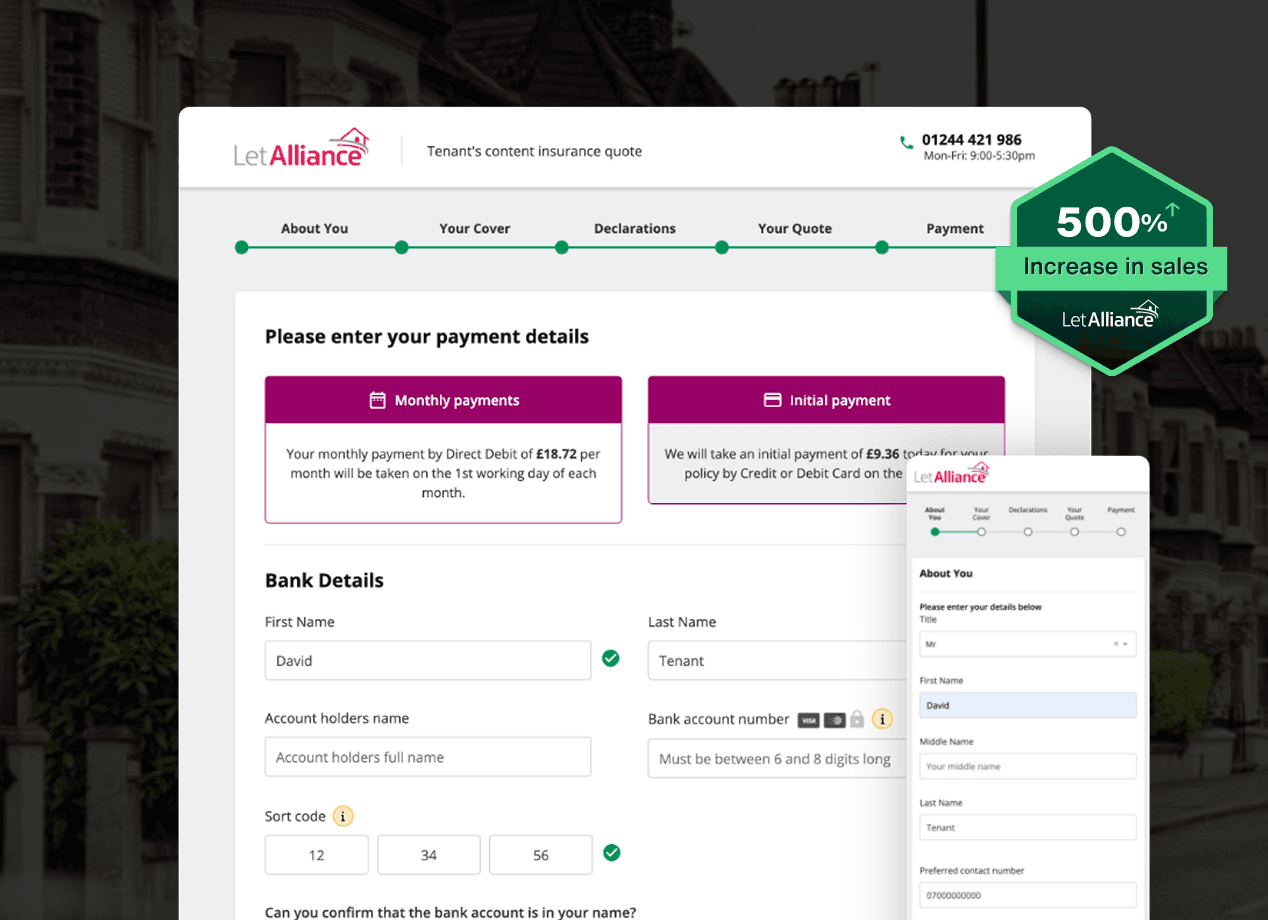
A complete, conversion-focused redesign, improving accessibility, clarity and performance across key rental sector user journeys.
Deliverables
(01) Responsive Web Design
(02) UX/UI
(03) User flows
(04) Sitemaps
(05) Wireframes
(06) Interactive Prototypes
The Challenge
The Let Alliance tenant contents insurance journey was attracting traffic, but it was failing where it mattered most.
Over half of users were abandoning the journey at step two.
On mobile, where most users were engaging, the experience felt cramped, heavy and unforgiving. Forms were long. Interactions were unclear. Error handling was inconsistent. For users who simply wanted to protect their belongings, the process felt more like a barrier than a service.
As the sole Web and UX Designer across Barbon Group, I was asked to investigate what was going wrong.
What I found was not a marketing problem.
It was a usability and accessibility problem.
The journey was not designed for real people, on real devices, in real life contexts.
The Vision
The ambition was not to improve conversion by small margins.
The ambition was to rebuild the journey so that it felt:
Fast
Clear
Reassuring
Mobile first
Accessible by default
The experience needed to guide users, not test their patience.
It needed to reduce anxiety, not introduce friction.
And it needed to work just as comfortably on a phone as it did on a desktop.
Buying insurance should feel simple.
Not stressful.
The Approach
This was not a cosmetic refresh.
Working closely with my manager and internal stakeholders, I completely rebuilt the quote and buy journey from the ground up.
Every screen was redesigned with:
Clear content hierarchy
Progressive disclosure
Plain language
Improved contrast and readability
Large, touch friendly interaction targets
Keyboard accessible flows
Predictable error handling
Mobile-first layouts
Forms were broken into calmer, more digestible steps.
Users were given reassurance, clarity and feedback at each stage.
Cognitive load was reduced significantly, particularly for mobile users completing the journey one handed.
Accessibility was embedded into the journey rather than layered on afterwards.
The Outcome
The impact was immediate and measurable.
Conversions increased by over 500 percent.
Sales grew from 33 to over 200 successful purchases.
Drop off at step two was dramatically reduced.
Mobile completion rates rose sharply.
Customer satisfaction improved significantly.
But more importantly, the journey stopped feeling like an obstacle.
It became simple.
Clear.
Approachable.
And genuinely supportive.
It did not just sell more insurance.
It made buying insurance feel fair.